
Mathematics
Mathematics Degree
Bachelor of Science, Bachelor of Arts, Minor
Program Type:
Major, Minor
Career Path:
STEM (Mathematics)
Program Site:
College or School:
Why study Mathematics?
Mathematics is at the core of how we understand the world, through patterns, logic, and structure. At Wake Forest, mathematics majors develop strong analytical and problem-solving skills while learning to think critically and communicate complex ideas clearly.
A major in mathematics will help you:
- Develop strong problem-solving and analytical reasoning skills
- Learn to think abstractly and construct logical arguments
- Communicate complex ideas clearly and precisely
- Build a foundation for a wide range of careers and graduate programs
- Gain intellectual flexibility that applies across disciplines
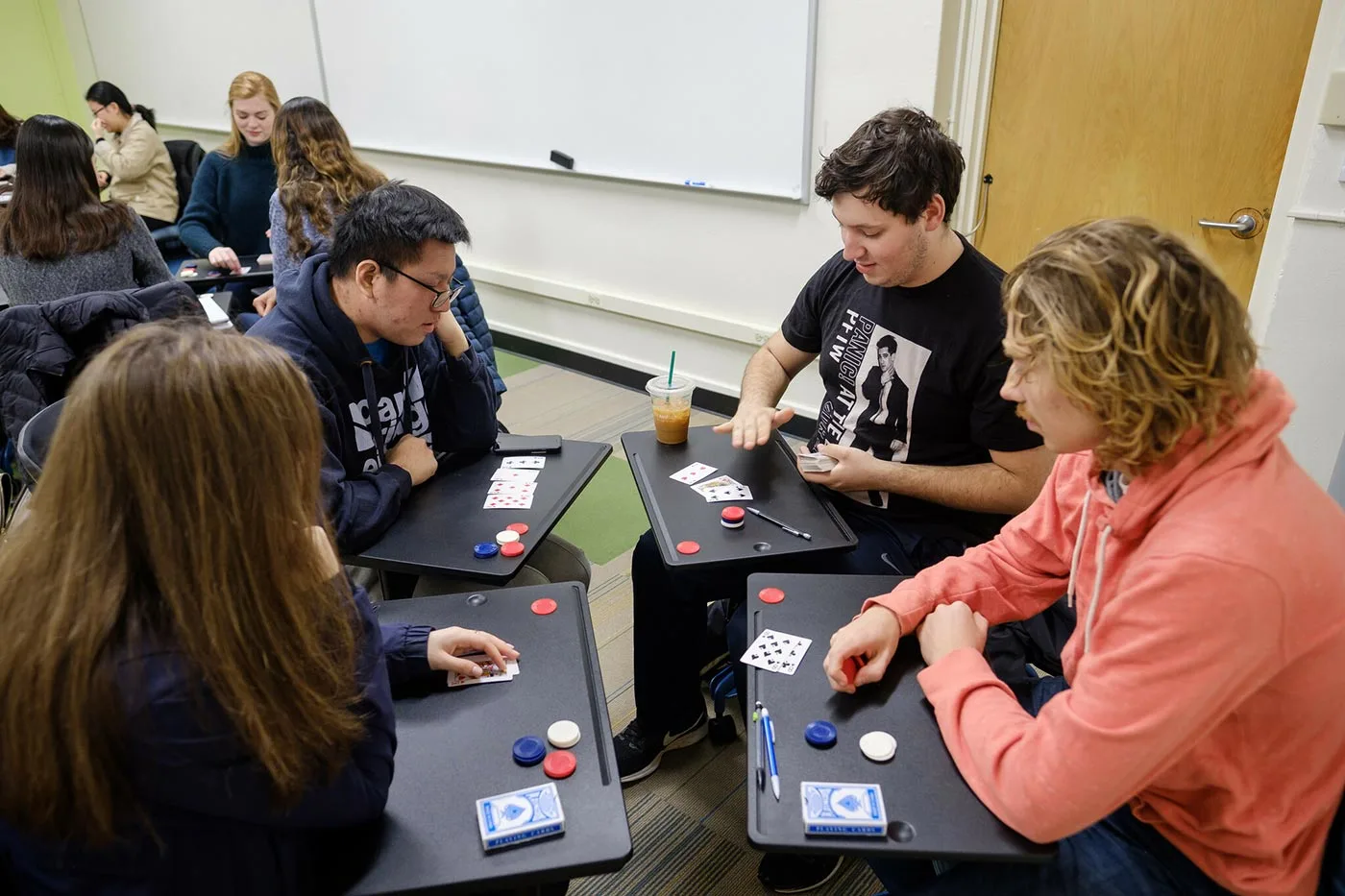
Mathematics majors at Wake Forest benefit from close interaction with faculty and a collaborative learning environment that reflects Wake Forest’s commitment to educating the whole student.
The Mathematics degree is offered as a Bachelor of Science (B.S.), Bachelor of Arts (B.A.), and a minor.
What classes would I take?
The mathematics major introduces students to both computational techniques and abstract reasoning. Courses emphasize problem solving, proof-writing, and mathematical communication. As you progress, courses become more conceptual, focusing on structure, theory, and rigorous reasoning.
Students generally take 100-200 level courses during their first two years of college, while registering for higher level courses as upperclassmen.
Sample courses* that you may take as a Mathematics student include:
100-200 level
- Calculus with Analytic Geometry II
- Multivariable Calculus
- Discrete Mathematics
- Linear Algebra I and II
- Axiomatic Systems
- Codes and Cryptography
300 level
- Introductory Real Analysis
- Modern Algebra
- Introductory Topology
- Graph Theory
- Combinatorial Analysis
- Modern Number Theory
* Course availability and offerings can change at any time. Refer to the Academic Bulletin to view all major requirements.
What kind of experience will I gain?
Mathematics students at Wake Forest engage deeply both inside and outside the classroom through a variety of hands-on and collaborative experiences:
- Undergraduate research with faculty on topics ranging from pure mathematics to interdisciplinary applications
- Independent studies and honors theses, allowing you to explore advanced topics in depth
- Mathematics and Statistics Center (MSC) tutoring and leadership opportunities
- Close faculty mentorship, including guidance on coursework, research, and career planning
- Collaborative classroom environments that emphasize discussion, problem solving, and communication
Students are also encouraged to pursue opportunities beyond the department, including:
- Summer research programs (REUs) and internships
- Study abroad, with courses that integrate mathematical perspectives across disciplines
- Interdisciplinary work in areas such as data science, economics, biology, and physics
These experiences help students build confidence, independence, and the ability to apply mathematical thinking in a wide range of settings.
Students in this program will develop the following skills:
- Analytical and logical reasoning
- Abstract thinking
- Problem solving
- Mathematical communication
- Proof writing and rigorous argumentation
- Intellectual independence
- Presentation and professional writing skills
- Quantitative analysis
- Adaptability
- Intellectual independence
Are there extracurricular activities?
Joining a club or organization is a great way to get involved and do more with your major. Our Mathematics students participate in the following programs:
- Association for Women in Mathematics
- Math Club
- Budapest semester in Mathematics
- National Science Foundation Research Experiences for Undergraduates
- Interdisciplinary Contest in Modeling
- Baseball Analytics Program
- WFU Fluids Dynamics Lab
What kind of job can I get?
Mathematics majors develop deep analytical and reasoning skills through the study of abstract structures, logical arguments, and rigorous problem solving. This focus prepares students especially well for graduate study in mathematics, data science, statistics, and economics as well as professional programs in law, medicine, or business.
On the professional side, employers value mathematics graduates for their ability to reason rigorously, learn new material quickly, and approach complex problems with clarity and precision. These skills translate across a wide range of fields, including technology and data, finance and business, and government and research, with career paths such as:
- Data analyst
- Cybersecurity analyst
- Software engineer
- Financial analyst
- Quantitative analyst
- Consultant
- Operations research analyst
- Policy analyst
- Staff scientist
Graduates have pursued careers in finance; data analysis; education; law; military service; and medicine, among others.
Related Programs

Majors & Minors
Choose from more than 50 majors and over 60 minors to find your perfect fit.

Life at Wake
Take a moment to explore all the student experiences that make Wake Forest unique.
Virtual Tour
Can’t make it for a visit? No problem! Let us show you around campus virtually.

Keep in Touch
Let us know you’re interested in Wake Forest and we’ll do the rest.

Visit Campus
You truly can’t appreciate the beauty of our campus until you experience it for yourself.

Apply
Want to be considered for our next class of Demon Deacons? Here’s how to get started.